Bead Weaving With Treasure Beads Book 1 Toho Beads Art Association
Beadwork is the art or craft of attaching beads to 1 another by stringing them onto a thread or thin wire with a sewing or beading needle or sewing them to fabric.[one] Beads are produced in a diverse range of materials, shapes, and sizes, and vary past the kind of art produced. Most often, beadwork is a class of personal adornment (e.grand. jewelry), simply information technology as well ordinarily makes upwards other artworks.
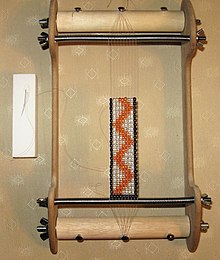
Beadwork in progress on a dewdrop weaving loom. Black, orangish and transparent seed beads are being used to make a bracelet.
Beadwork techniques are broadly divided into several categories, including loom and off-loom weaving, stringing, bead embroidery, bead crochet, bead knitting, and bead tatting.[2]
Ancient beading [edit]
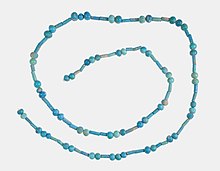
The art of creating and utilizing beads is ancient, and ostrich trounce beads discovered in Africa can be carbon-dated to 10,000 BC.[three] [four] Faience chaplet, a type of ceramic created by mixing powdered clays, lime, soda, and silica sand with water until a paste forms, then molding it effectually a stick or straw and firing until hard, were notably used in aboriginal Egyptian jewelry from the Showtime Dynasty (start in the early Bronze age) onward.[5] [half-dozen] Faience and other ceramic chaplet with vitrified quartz coatings predate pure glass beads.[seven]
Beads and work created with them were found near-ubiquitously across the ancient earth, frequently fabricated of locally bachelor materials. For case, the Athabaskan peoples of Alaska used tusk shells (scaphopod mollusks), which are naturally hollow, as beads and incorporated them into elaborate jewelry.[8]
Beadwork has historically been used for religious purposes, as skilful luck talismans, for barter and merchandise, and for ritual exchange.[iv]
Modern beading [edit]

Polar bear made of pearl beads, an example of a modern beadwork projection
Today, beadwork is normally practiced by jewelers, hobbyists, and contemporary artists; artists known for using beadwork as a medium include Liza Lou, Ran Hwang, Hew Locke, Jeffery Gibson, and Joyce J. Scott.[9]
Some aboriginal stitches have become especially pop among contemporary artists. The off-loom peyote stitch, for instance, is used in Native American Church building members' beadwork.[10]
European beadwork [edit]
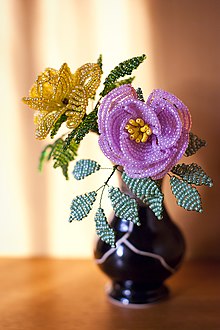
Modern beaded flowers, yellow made in the French beading technique and pink in the Victorian beading technique.
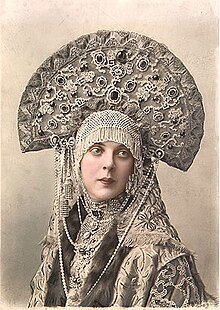
Russian Countess Olga Orlova-Davydova wearing a heavily beaded kokoshnik at the Masquerade Costume Ball of 1903
Beadwork in Europe, much like in Egypt and the Americas, tin can exist traced to the use of os and trounce as adornments amongst early on modern humans.[3] As glassmaking increased in popularity through the Heart Ages, glass chaplet began to appear extensively in bead embroidery, beaded necklaces, and similar wares.[xi]
Past 1291, artists in Murano, Italy had begun production of intricate glass Murano beads inspired by Venetian glassware. With the advent of lampwork glass, Europeans started producing seed beads for embroidery, crochet, and other, mostly off-loom techniques.[7] Czech seed chaplet are amid the most popular contemporary bead styles.
One technique of European beadwork is beaded "immortal" flowers. The technique's origins, though indistinct, are generally agreed to range at least several centuries back, as far back as at to the lowest degree the 16th if non 14th century.[12] [xiii] 2 mayor styles were developed: French beading, in which the wire just goes through each bead once and the wires are arranged vertically, and Victorian (also called English or Russian) beading, in which the wires go through each bead twice and are arranged horizontally.[12] In the belatedly 19th and early 20th century, the beaded flowers were used to create long lasting funeral wreaths, chosen immortelles (French for "immortals").[13] In the mid-20th century, the art was introduced to United states with sales of blossom beading kits. In 1960s to 1970s, books by emerging beaded flower designers emerged.[12] [13] In the 1990s and 2000s, there was some other revival of interest in the craft, exemplified for example by the funeral wreaths made to commemorate September 11 attacks victims.[12]
Beadwork is a fundamental component of the traditional apparel of many European peoples. In Northern Russia, for example, the Kokoshnik headdress typically includes river pearl netting effectually the forehead in addition to traditional bead embroidery.[fourteen]
Native American beadwork [edit]

Examples of gimmicky Native American beadwork
Native American beadwork, already established via the use of materials similar shells, dendrite, claws, and bone, evolved to comprise drinking glass chaplet as Europeans brought them to the Americas beginning in the early 17th century.[15] [16]
Native beadwork today heavily utilizes pocket-sized glass beads, but artists also continue to use traditionally important materials. Wampum shells, for instance, are ceremonially and politically important to a range of Eastern Woodlands tribes, and are used to depict of import events.[17]
Several Native American artists from a wide range of nations are considered to be at the forefront of modern American bead working. These artists include Teri Greeves (Kiowa, known for beaded commentaries on Native voting rights),[18] Marcus Amerman (Choctaw, known for realistic beaded portraits of historical figures and celebrities),[19] and Jamie Okuma (Luiseño-Shoshone-Bannock, known for beaded dolls).[20]
Great Lakes tribes [edit]
Ursuline nuns in the Corking Lakes introduced floral patterns to immature Ethnic women, who quickly practical them to beadwork.[21] Ojibwe women in the area created ornately decorated shoulder bags known as gashkibidaagan (bandolier bags).[22]
Eastern Woodlands tribes [edit]
Innu, Mi'kmaq, Penobscot, and Haudenosaunee peoples adult, and are known for, beading symmetrical roll motifs, about ofttimes in white chaplet.[23] Tribes of the Iroqouis Confederacy practise raised beading, where threads are pulled taut to force chaplet into a bas-relief, which creates a iii-dimensional consequence.[24] [25]
Southeastern tribes [edit]
Southeastern tribes pioneered a beadwork style that features images with white outlines, a visual reference to the shells and pearls coastal Southeasterners used pre-contact.[26] This manner was nearly lost during the Trail of Tears, as many beadworkers died during their forced removal to Indian Territory w of the Mississippi River. Roger Amerman (Choctaw, brother of Marcus Amerman) and Martha Berry (Cherokee) have finer revived the style, however.[26]
Sierra Madre tribes [edit]
Huichol communities in the Mexican states of Jalisco and Nayarit uniquely attach their beads to objects and surfaces via the apply of a resin-beeswax mixture (in lieu of wire or waxed thread).[27]
African beadwork [edit]

Several African nations outside of Egypt accept beadwork traditions. Aggry (as well spelled aggri or aggrey) beads, a type of busy glass bead, are used past Ghanians and other West Africans to make necklaces and bracelets that may be traded for other goods.[28] These beads are often believed to accept magical medicinal of fertility powers. In Mauritania, powder-drinking glass Kiffa beads stand for a beading tradition that may appointment as far dorsum as 1200 CE; a group of women accept been revitalizing the craft after the last traditional Kiffa artisans died in the 1970s.[29] Cameroonian women are known for crafting wooden sculptures covered in beadwork.[xxx]
See also [edit]
- Glass beadmaking
- Murano beads
- Bead embroidery
References [edit]
- ^ "Beadwork". Merriam-Webster . Retrieved 3 May 2014.
- ^ Libin, Nina (1998). Tatted Lace of Beads, the Techniques of BEANILE LACE. Berkeley, CA: LACIS. p. 112. ISBN0-916896-93-v.
- ^ a b Dubin, Lois Sherr (2009). The History of Chaplet: From 100,000 B.C. to the Present. New York: Harry Northward. Abrams. p. 16. ISBN978-0810951747.
- ^ a b Sciama, Lidia D.; Eicher, Joanne B. (1998). Beads and Bead Makers: Gender, Textile Civilisation and Meaning (Cross-Cultural Perspectives on Women). Bloomsbury Publishing. pp. ane–three. ISBN978-1859739952.
- ^ Dee, Michael; Wengrow, David; Shortland, Andrew; Stevenson, Alice; Brock, Fiona; Girdland Flink, Linus; Bronk Ramsey, Christopher (8 November 2013). "An absolute chronology for early on Egypt using radiocarbon dating and Bayesian statistical modelling". Proceedings of the Royal Order A: Mathematical, Physical and Engineering Sciences. 469 (2159): 20130395. doi:10.1098/rspa.2013.0395. ISSN 1364-5021. PMC3780825. PMID 24204188.
- ^ Peck, William (2013). The Material Globe of Ancient Arab republic of egypt. Cambridge Academy Printing. ISBN978-1107276383.
- ^ a b Dubin, Lois Sherr (2010). The Worldwide History of Beads: Ancient, Ethnic, Contemporary. Thames & Hudson. ISBN9780500515006.
- ^ Dubin, Lois Sherr (2009). The History of Beads: From 100,000 B.C. to the Present. New York: Abrams. p. 463. ISBN978-0810951747.
- ^ Gittlen, Ariela (xvi February 2018). "six Artists Turning Beads into Spellbinding Works of Fine art". Cocked . Retrieved nineteen October 2020.
- ^ Steele, Meredith (23 May 2019). "Peyote Sew: A Brief History". Interweave. Archived from the original on xiv June 2020. Retrieved 22 July 2021.
- ^ Keller, Daniel; Price, Jennifer; Jackson, Caroline (2014). Neighbours and Successors of Rome: Traditions of Glass Production and use in Europe and the Eye East in the Later 1st Millennium Advertisement. Oxbow Books. pp. 1–41. ISBN978-one-78297-398-0.
- ^ a b c d Kurtz, Rosemary (16 February 2008). "French Bead Bloom Making - A Vintage Craft Is New Over again".
- ^ a b c Harpster, Lauren (31 August 2018). "What is French Beading?". Bead & Flower . Retrieved 22 April 2022.
- ^ "Headdress of Natalia de Shabelsky". Met Museum. Archived from the original on 2 March 2017.
- ^ "Native American Art- Cherokee Beadwork and Basketry". nativeamerican-art.com . Retrieved 14 Nov 2017.
- ^ Cherokee, Eastern Ring of. "Cherokee Indian Beadwork and Beading Patterns | Cherokee, NC". Cherokee, NC . Retrieved 14 November 2017.
- ^ Dubin, pp. 170–171
- ^ Lopez, Antonio (August 2000). "Focus on Native Artists | Teri Greeves". Southwest Art Magazine . Retrieved thirteen March 2009.
- ^ Berlo and Phillips, p. 32
- ^ Indyke, Dottie (May 2001). "Native Arts | Jamie Okuma". Southwest Art Magazine . Retrieved xiii March 2009.
- ^ Dubin, p. fifty
- ^ Dubin, p. 218
- ^ Berlo and Phillips, p. 146
- ^ Hoffman, Karen Ann. "Wisconsin Life, Iroquois Beadwork". Wisconsin First Nations. Archived from the original on 22 July 2021.
- ^ Berlo and Philips, p. 151
- ^ a b Berlo and Phillips, p. 87
- ^ Hillman, Paul. "The Huichol Web of Life: Cosmos and Prayer | Lesson Two: Jicaras, Kukus and Seeds". Customs Arts Resources Substitution. The Bead Museum. Archived from the original on xviii May 2008. Retrieved 13 March 2009.
- ^ Quiggin, A. Hingston (1949). A Survey of Primitive Money. London: Methuen & Co Ltd. pp. 36–44.
- ^ Simak, E. "Mauritanian Powder-Glass Kiffa Beads". Ornament. v (29): sixty–63.
- ^ LaDuke, Betty. (1997). Africa : women'southward fine art, women'south lives. Trenton, NJ: Africa World Press. pp. 63–84. ISBN0-86543-434-4. OCLC 35521674.
- Berlo, Janet C.; Ruth B. Phillips (1998). Native North American Art . Oxford History of Fine art. Oxford University Press. ISBN978-0-19-284218-three.
- Dubin, Lois Sherr (1999). North American Indian Jewelry and Adornment: From Prehistory to the Nowadays. New York: Harry Due north. Abrams. ISBN 0-8109-3689-v
- Dubin, Lois Sherr (2009). The History of Beads: From 100,000 B.C. to the Nowadays. New York: Harry N. Abrams. ISBN 978-0810951747.
- Beads and beadwork. (1996). In Encyclopedia of due north american indians, Houghton Mifflin. Retrieved 27 January 2014, from http://search.credoreference.com/
External links [edit]
 | Wikimedia Commons has media related to Beadwork. |
hildebrandwitimpet.blogspot.com
Source: https://en.wikipedia.org/wiki/Beadwork
0 Response to "Bead Weaving With Treasure Beads Book 1 Toho Beads Art Association"
Post a Comment