Can You Set Facebook to Stop Showing People You May Know
Is social media bad for you? The prove and the unknowns
(Epitome credit:
Getty Images
)
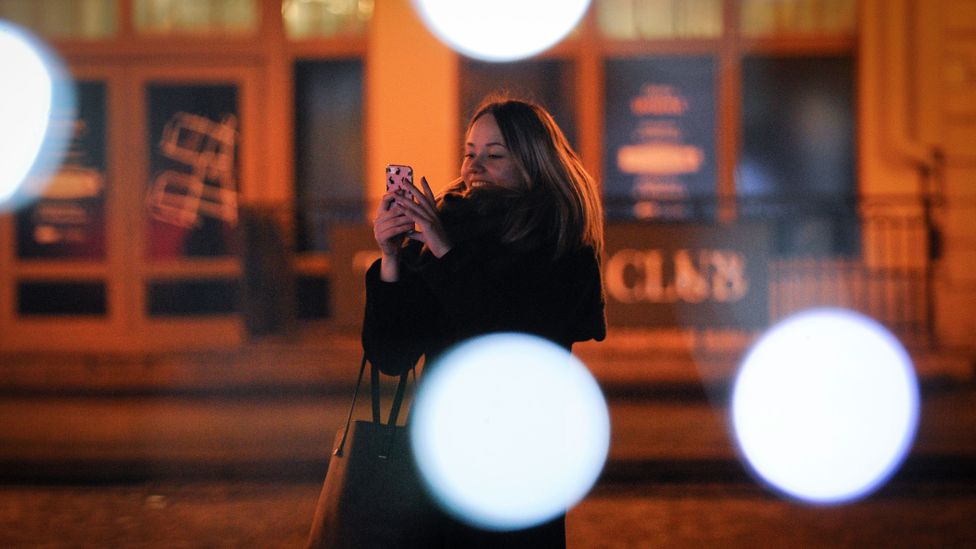
What the scientific discipline suggests so far about the impact of platforms such as Facebook, Twitter or Instagram on your mental well-being.
#LikeMinded
A special serial nigh social media and well-being
This month, BBC Future is exploring social media's bear on on mental wellness and well-beingness – and seeking solutions for a happier, healthier experience on these platforms. Stay tuned for more stories, coming soon…
Share your tips for a happy life on social media with the hashtag #LikeMinded on Facebook, Twitter and Instagram.

This story is featured in BBC Future'due south "Best of 2018" drove. Discover more of our picks.
Three billion people, around forty% of the earth's population, use online social media – and we're spending an average of ii hours every day sharing, liking, tweeting and updating on these platforms, co-ordinate to some reports. That breaks down to around half a 1000000 tweets and Snapchat photos shared every minute.
With social media playing such a big part in our lives, could we exist sacrificing our mental health and well-being as well as our time? What does the bear witness actually propose?
- Facebook responds to mental well-being claims
- Is information technology fourth dimension to rethink how nosotros use social media? An introduction to our #LikeMinded flavour
Since social media is relatively new to us, conclusive findings are limited. The enquiry that does exist mainly relies on self-reporting, which can oft exist flawed, and the majority of studies focus on Facebook. That said, this is a fast-growing area of enquiry, and clues are kickoff to emerge. BBC Future reviewed the findings of some of the scientific discipline and then far:
STRESS
People utilize social media to vent about everything from customer service to politics, only the downside to this is that our feeds often resemble an endless stream of stress. In 2015, researchers at the Pew Inquiry Heart based in Washington DC sought to observe out if social media induces more stress than it relieves.
In the survey of 1,800 people, women reported existence more than stressed than men. Twitter was found to be a "pregnant contributor" considering it increased their awareness of other people'southward stress.
Only Twitter also acted as a coping mechanism – and the more women used it, the less stressed they were. The same issue wasn't found for men, whom the researchers said had a more distant relationship with social media. Overall, the researchers concluded that social media use was linked to "modestly lower levels" of stress.
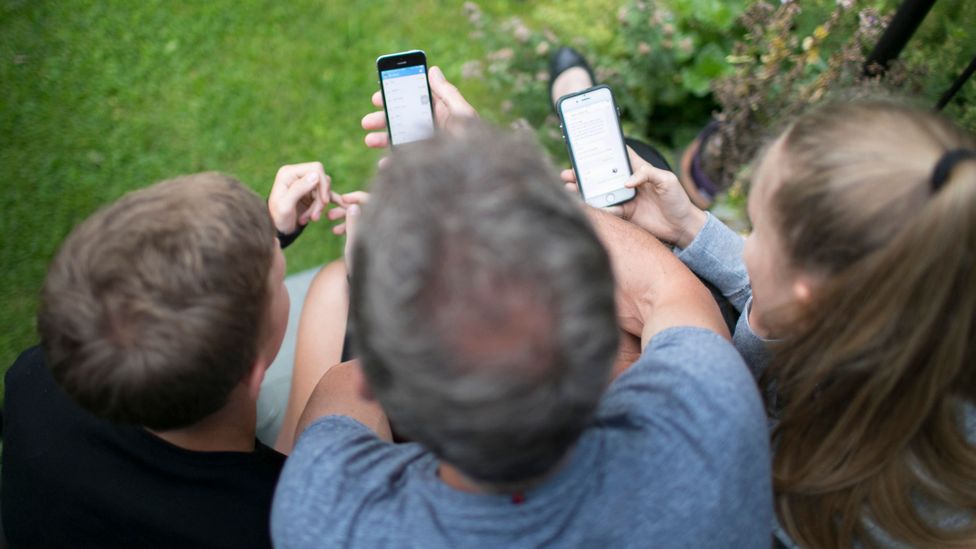
The presence of a telephone affects the quality of conversation, some studies suggest (Credit: Getty Images)
MOOD
In 2014, researchers in Austria found that participants reported lower moods later using Facebook for 20 minutes compared to those who just browsed the internet. The study suggested that people felt that way because they saw information technology as a waste of fourth dimension.
A proficient or bad mood may also spread betwixt people on social media, according to researchers from the University of California, who assessed the emotional content of over a billion status updates from more than 100 1000000 Facebook users betwixt 2009 and 2012.
Bad weather condition increased the number of negative posts past 1%, and the researchers found that one negative postal service past someone in a rainy city influenced another i.3 negative posts by friends living in dry cities. The amend news is that happy posts had a stronger influence; each one inspired i.75 more happy posts. Whether a happy post translates to a genuine boost in mood, however, remains unclear.
ANXIETY
Researchers have looked at general anxiety provoked past social media, characterised by feelings of restlessness and worry, and trouble sleeping and concentrating. A study published in the journal Computers and Man Behaviour found that people who report using seven or more social media platforms were more than than three times every bit likely as people using 0-2 platforms to have high levels of general anxiety symptoms.
That said, information technology's unclear if and how social media causes anxiety. Researchers from Babes-Bolyai University in Romania reviewed existing research on the human relationship between social anxiety and social networking in 2016, and said the results were mixed. They concluded that more research needs to be washed.
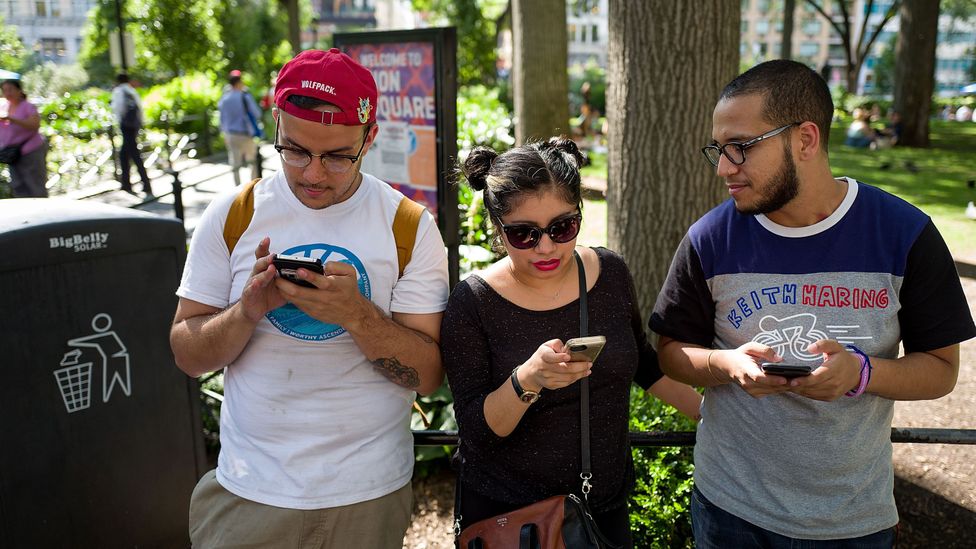
Social media mimics many of the rewards of games and play, which can pose an attractive lure (Credit: Getty Images)
Low
While some studies have found a link between low and social media use, there is emerging research into how social media can actually be a force for good.
2 studies involving more than than 700 students found that depressive symptoms, such as low mood and feelings of worthlessness and hopelessness, were linked to the quality of online interactions. Researchers found higher levels of depressive symptoms among those who reported having more than negative interactions.
A similar study conducted in 2016 involving 1,700 people found a threefold risk of depression and anxiety amid people who used the most social media platforms. Reasons for this, they suggested, include cyber-bullying, having a distorted view of other people's lives, and feeling similar time spent on social media is a waste.
However, every bit BBC Future will explore this month in our #LikeMinded flavor, scientists are also looking at how social media can be used to diagnose depression, which could assistance people receive handling earlier. Researchers for Microsoft surveyed 476 people and analysed their Twitter profiles for depressive language, linguistic style, engagement and emotion. From this, they developed a classifier that can accurately predict depression before information technology causes symptoms in 7 out of 10 cases.
Researchers from Harvard and Vermont Universities analysed 166 people's Instagram photos to create a similar tool final yr with the aforementioned success rate.
SLEEP
Humans used to spend their evenings in darkness, but now we're surrounded by artificial lighting all day and night. Research has found that this can inhibit the body's production of the hormone melatonin, which facilitates sleep – and blueish light, which is emitted by smartphone and laptop screens, is said to be the worst culprit. In other words, if you lie on the pillow at night checking Facebook and Twitter, you lot're headed for restless sleep.
Last twelvemonth, researchers from the University of Pittsburgh asked 1,700 18- to 30-twelvemonth-olds almost their social media and sleeping habits. They plant a link with sleep disturbances – and concluded blue lite had a part to play. How oft they logged on, rather than fourth dimension spent on social media sites, was a college predictor of disturbed sleep, suggesting "an obsessive 'checking'", the researchers said.
The researchers say this could exist caused by physiological arousal before sleep, and the brilliant lights of our devices can delay circadian rhythms. But they couldn't clarify whether social media causes disturbed sleep, or if those who take disturbed sleep spend more than time on social media.
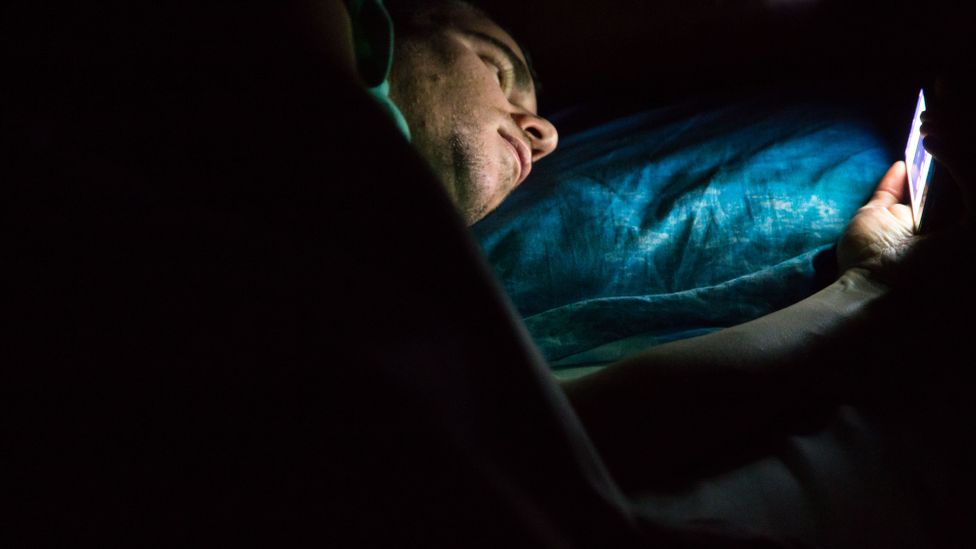
1 of the worst times to utilize social media may be just before bed (Credit: Getty Images)
Addiction
Despite the argument from a few researchers that tweeting may be harder to resist than cigarettes and alcohol, social media addiction isn't included in the latest diagnostic manual for mental health disorders.
That said, social media is changing faster than scientists tin continue up with, and then diverse groups are trying to study compulsive behaviours related to its use – for example, scientists from the netherlands accept invented their ain scale to place possible addiction.
And if social media addiction does exist, it would be a blazon of net addiction – and that is a classified disorder. In 2011, Daria Kuss and Mark Griffiths from Nottingham Trent University in the UK have analysed 43 previous studies on the thing, and conclude that social media addiction is a mental wellness problem that "may" require professional treatment. They institute that excessive usage was linked to relationship problems, worse academic accomplishment and less participation in offline communities, and constitute that those who could be more vulnerable to a social media addiction include those dependent on alcohol, the highly extroverted, and those who apply social media to recoup for fewer ties in real life.
Self-ESTEEM
Women's magazines and their utilize of underweight and Photoshopped models have been long maligned for stirring cocky-esteem bug among young women. Simply now, social media, with its filters and lighting and clever angles, is taking over as a master concern among some campaigning groups and charities.
Social media sites brand more than half of users feel inadequate, according to a survey of 1,500 people by disability charity Scope, and half of xviii- to 34-twelvemonth-olds say it makes them experience unattractive.
A 2016 study past researchers at Penn State University suggested that viewing other people's selfies lowered self-esteem, because users compare themselves to photos of people looking their happiest. Inquiry from the University of Strathclyde, Ohio University and University of Iowa also plant that women compare themselves negatively to selfies of other women.
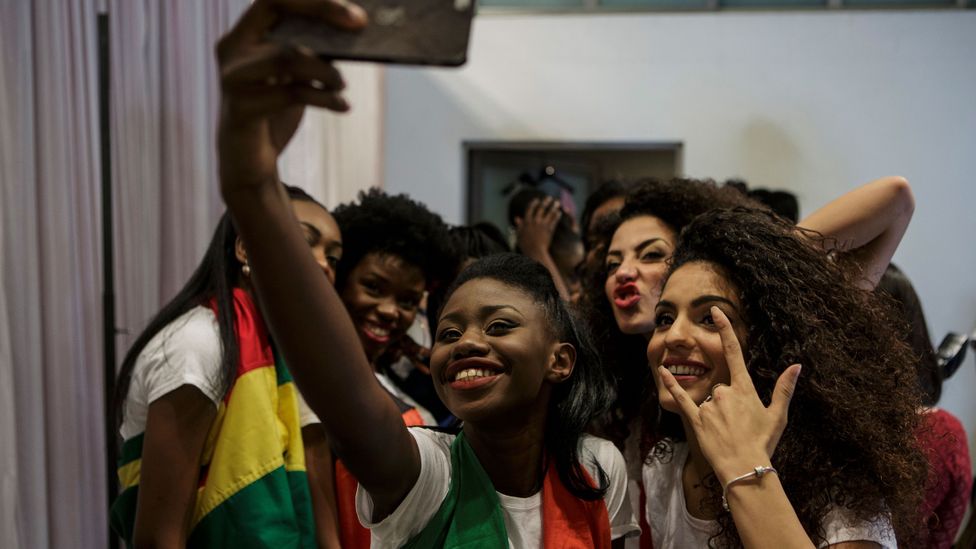
Selfies may take downsides for the viewer (Credit: Getty Images)
Merely it's not just selfies that have the potential to paring self-esteem. A study of ane,000 Swedish Facebook users plant that women who spent more time on Facebook reported feeling less happy and confident. The researchers ended: "When Facebook users compare their own lives with others' seemingly more successful careers and happy relationships, they may feel that their own lives are less successful in comparing."
But one small study hinted that viewing your own contour, not others, might offer ego boosts. Researchers at Cornell Academy in New York put 63 students into different groups. Some sat with a mirror placed against a computer screen, for instance, while others sat in forepart of their own Facebook profile.
Facebook had a positive effect on cocky-esteem compared to other activities that boost cocky-awareness. Mirrors and photos, the researchers explained, brand united states of america compare ourselves to social standards, whereas looking at our own Facebook profiles might boost cocky-esteem because it is easier to control how we're presented to the world.
WELL-BEING
In a study from 2013, researchers texted 79 participants five times a day for xiv days, request them how they felt and how much they'd used Facebook since the final text. The more time people spent on the site, the worse they felt afterward, and the more their life satisfaction declined over time.
Simply other research has found, that for some people, social media can assist boost their well-being. Marketing researchers Jonah Berger and Eva Buechel found that people who are emotionally unstable are more likely to post about their emotions, which tin can assist them receive support and bounce back after negative experiences.
Overall, social media's effects on well-being are ambiguous, according to a paper written terminal year by researchers from holland. However, they suggested there is clearer evidence for the impact on i group of people: social media has a more negative consequence on the well-being of those who are more socially isolated.
In some cases, social media may raise well-being (Credit: Getty Images)
RELATIONSHIPS
If you've ever been talking to a friend who's pulled their phone out to scroll through Instagram, you might have wondered what social media is doing to relationships.
Even the mere presence of a phone tin can interfere with our interactions, especially when we're talking about something meaningful, according to one small study. Researchers writing in the Journal of Social and Personal Relationships tasked 34 pairs of strangers with having a ten-minute conversation near an interesting upshot that had happened to them recently. Each pair sat in private booths, and one-half had a mobile phone on the superlative of their table.
Those with a telephone in eyeshot were less positive when recalling their interaction later, had less meaningful conversations and reported feeling less close to their partner than the others, who had a notebook on top of the table instead.
Romantic relationships aren't immune, either. Researchers at the University of Guelph in Canada surveyed 300 people aged 17-24 in 2009 about whatever jealousy they felt when on Facebook, asking questions such as, 'How likely are you to become jealous after your partner has added an unknown member of the opposite sexual activity?'.
Women spent much more than fourth dimension on Facebook and so men, and experienced significantly more jealousy when doing so. The researchers ended they "felt the Facebook environment created these feelings and enhanced concerns about the quality of their relationship".
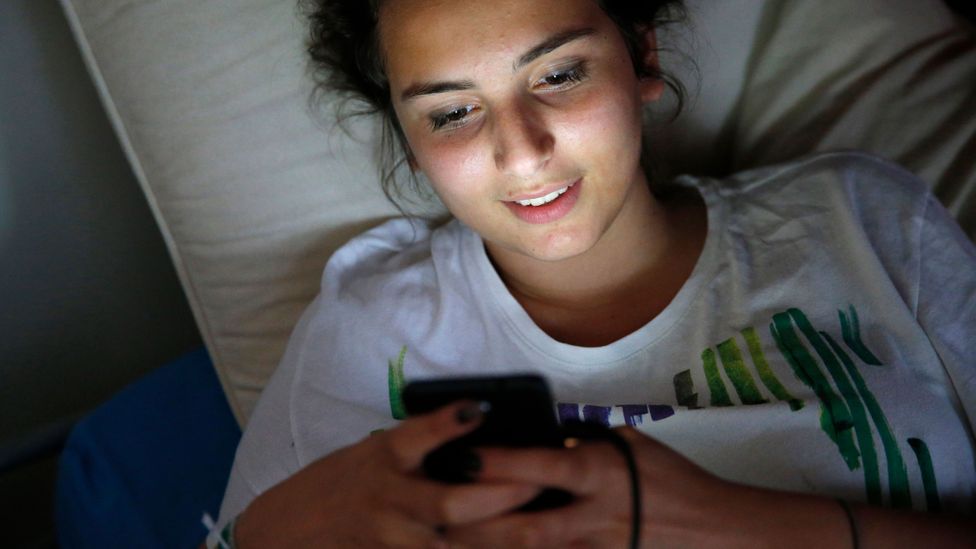
In one survey of ane,800 people, women reported beingness more stressed past social media than men (Credit: Getty Images)
Green-eyed
In a study involving 600 adults, roughly a tertiary said social media made them feel negative emotions – mainly frustration – and green-eyed was the main cause. This was triggered by comparing their lives to others', and the biggest culprit was other people'due south travel photos. Feeling envious caused an "envy spiral", where people react to green-eyed by adding to their profiles more of the same sort of content that made them jealous in the beginning place.
However, envy isn't necessarily a subversive emotion – it can ofttimes make us work harder, according to researchers from Michigan University and the Academy of Wisconsin-Milwaukee. They asked 380 students to look at "green-eyed-eliciting" photos and texts from Facebook and Twitter, including posts about buying expensive goods, travelling and getting engaged. But the type of envy the researchers institute is "benign envy", which they say is more likely to brand a person work harder.
LONELINESS
A written report published in the American Periodical of Preventive Medicine last year surveyed 7,000 19- to 32-year-olds and found that those who spend the most fourth dimension on social media were twice as probable to report experiencing social isolation, which tin can include a lack of a sense of social belonging, appointment with others and fulfilling relationships.
Spending more than time on social media, the researchers said, could displace face-to-face interaction, and can also make people feel excluded.
"Exposure to such highly idealised representations of peers' lives may elicit feelings of envy and the distorted belief that others atomic number 82 happier and more successful lives, which may increase perceived social isolation."
CONCLUSIONS?
It's clear that in many areas, not enough is known even so to describe many strong conclusions. All the same, the evidence does point one manner: social media affects people differently, depending on pre-existing conditions and personality traits.
As with nutrient, gambling and many other temptations of the modern historic period, excessive use for some individuals is probably inadvisable. Just at the aforementioned time, it would be wrong to say social media is a universally bad thing, considering clearly it brings myriad benefits to our lives.
Nosotros'll be exploring this tension more over the adjacent month, in a series of manufactures and videos in our special series #LikeMinded – and hopefully providing solutions that could aid us all live a happier, healthier digital life.
Bring together 800,000+ Hereafter fans past liking us on Facebook , or follow united states on Twitter .
If you liked this story, sign upward for the weekly bbc.com features newsletter , called "If Y'all Merely Read 6 Things This Week". A handpicked choice of stories from BBC Time to come, Civilisation, Capital letter, and Travel, delivered to your inbox every Fri.
hildebrandwitimpet.blogspot.com
Source: https://www.bbc.com/future/article/20180104-is-social-media-bad-for-you-the-evidence-and-the-unknowns
0 Response to "Can You Set Facebook to Stop Showing People You May Know"
Post a Comment