What Is the Maximum Distance That an Adsl Modem (Client) Can Be From a Provider's Dslam?
Our own networks are called LANs (Local Area Network). We own and operate these networks. It'south called a "local" area network since all devices that make upwardly the LAN are close to each other. Perhaps in ane edifice or a few buildings close to each other (called a campus).
When we need access to other remote networks, connect two LANs together or give others admission to our LAN, we need a WAN (Wide Expanse Network). As the proper noun implies, WANs cover large geographical areas. This could be a network between two cities or as big as the Internet.
WANs are operated by companies like phone/cable companies, service providers, or satellite companies. They build large networks that span entire cities or regions and charter the right to utilize their networks to their customers.
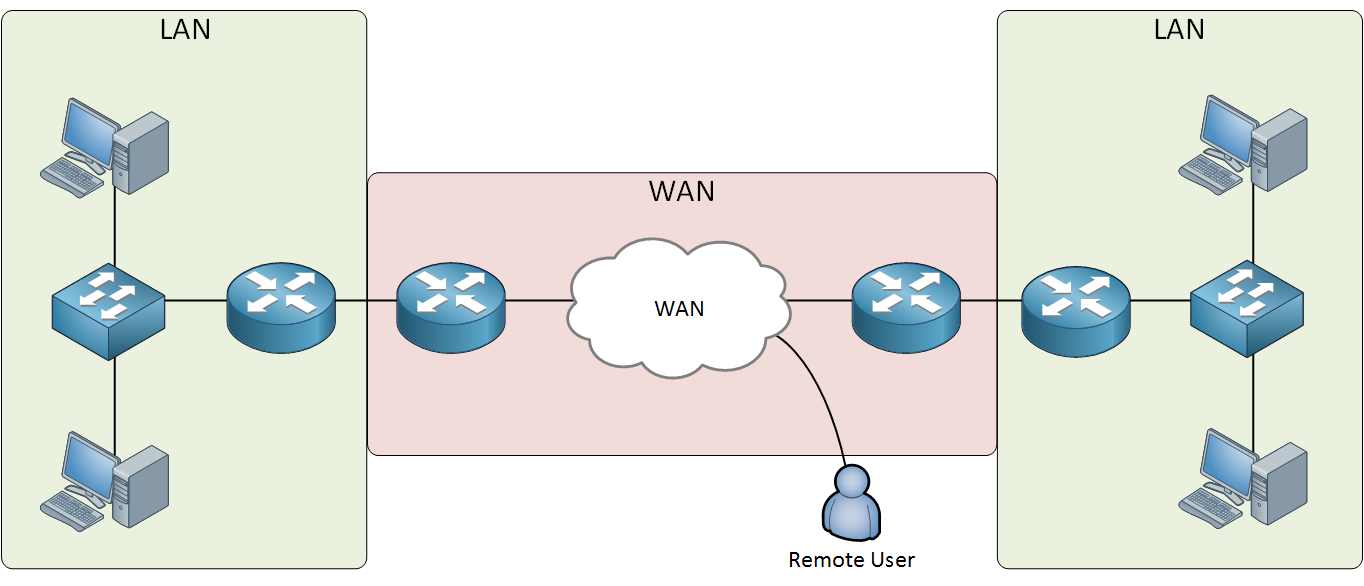
On the LAN, the dominant protocol that we use is Ethernet. For wide area networks, there are dozens of technologies and protocols nosotros can choose from. Nigh WAN technologies describe layer ane and ii of the OSI model:
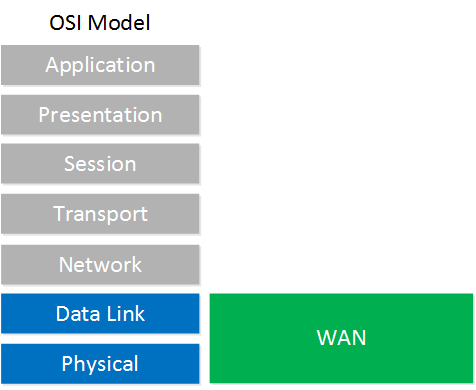
On the physical layer, we use different hardware, cables, connectors and interfaces. On the data link layer, in that location are a number of different WAN protocols that we tin employ. We'll discuss these.
Physical Layer Terminology
When you read about WAN technologies and protocols, there is a lot of terminology y'all might encounter. Permit'southward await at a motion picture:
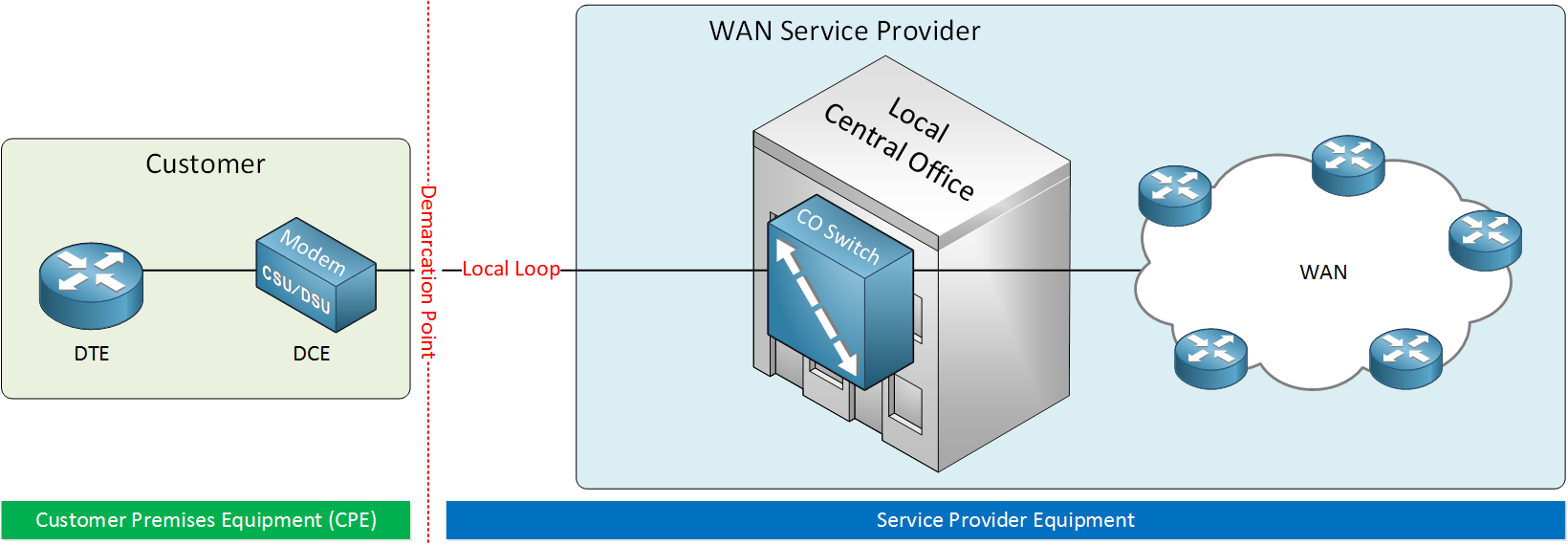
The moving-picture show above is what a WAN solution in full general looks like. Let me walk you through the different items in the picture:
- On the left side in the green box, nosotros have the client network that is paying for the services of the WAN service provider.
- On the right side, in the bluish box, we have the WAN service provider with its hardware.
- The CPE (Customer Bounds Equipment) are all devices, wiring, and hardware that are located at the site of the client. These devices are continued to the WAN of the WAN service provider. The CPE might be owned by the customer or leased from the service provider. A combination is as well possible. Possibly the router is owned by the customer and the modem is leased from the service provider.
- All hardware and devices that belong to the service provider is called the service provider equipment.
- The demarcation point (demarc) is where the service provider's wiring ends and where the customer'due south wiring begins. Depending on which country you live in, this could exist a then-called meter box/meter cupboard inside or outside your business firm or building.
- The DTE (Data Terminal Equipment) is the client device that forwards information from the customer's network to the WAN. This can be a router, computer or sometimes a switch.
- The CSU/DSU (Channel Service Unit / Data Service Unit of measurement)is a device that sits in between the router and WAN connectedness. Information technology converts digital signals from the WAN into a digital signal the router understands and vice versa. For case, the CSU/DSU might be continued to the router with a DTE serial cable, and so it has to speak a language the router understands. On the other side, the CSU/DSU is connected to a two pair cable to the WAN service provider which speaks some other language. Back in the days, the CSU/DSU was a separate device. Nowadays this is integrated in router interfaces.
- The DCE (Information Circuit-terminating Equipment) is the device that receives data from the DTE, modulates into an analog signal and forwards information technology onto the wire to the service provider. It also demodulates analog signals that it receives on the wire into digital signals. This device is a modem and nowadays often integrated in interfaces or routers.
- The local loop is the concrete link that connects from the demarcation point at the customer to the edge of the service provider network. Information technology'due south also frequently called the "last mile".
- The CO (Cardinal Office) is the building where all lines from local loops to the customers finish up. In this edifice, we will find CO switches where the lines terminate. The kind of CO switch used depends on the engineering that is used (telephony, DSL, cable, etc.).
WAN Technologies
There are a number of different methods how we can forward information on a network:
- Circuit switching
- Packet switching
- Prison cell switching
Allow me explain these and prove you some examples.
Circuit Switching
To understand circuit switching, it'due south best to look at how telephony worked back in the 60s:
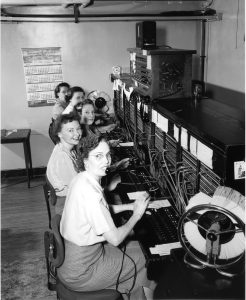
The telephone network used telephone switchboards that were operated by switchboard operators who connected calls by plugging in phone plugs in the required phone jacks. To connect long distance calls, operators had to work together with operators in other offices.
Once the correct plugs were connected, a excursion was established betwixt two callers which immune them to talk to each other. Here'southward a visualization:
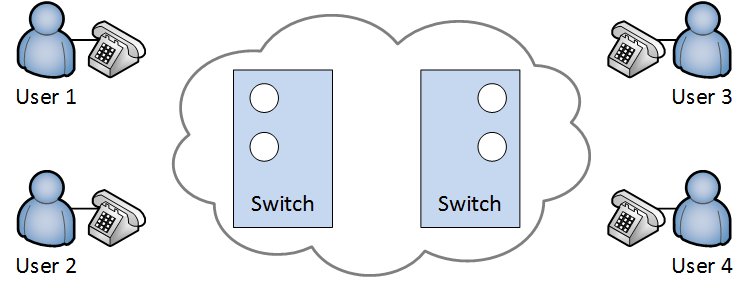
In a higher place we have four users, the deject is the telephone network with ii switchboards. Let's say user 1 and user 3 would like to talk to each other. The operators would plug in the required phone plugs to establish a excursion like this:
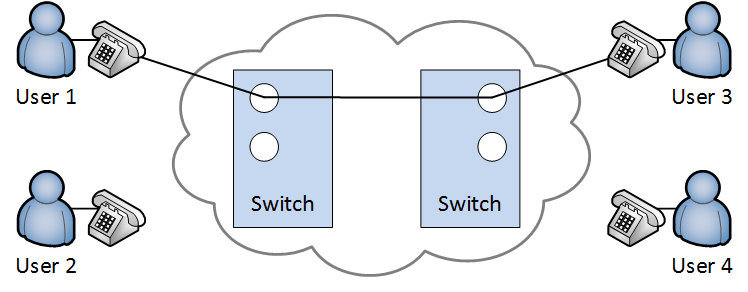
The circuit that is established is used exclusively by user ane and user 3. It doesn't matter if they talk a lot or relish each other'south silence, nobody else can employ this circuit. User ii and user four would besides like to talk to each other. Later on connecting the right phone plugs, the circuit is established:
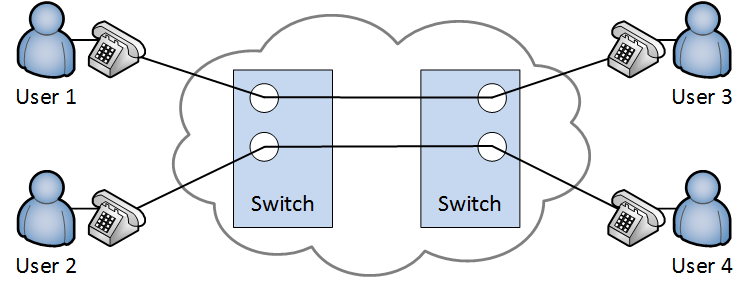
Nosotros now accept two circuits and the network is at 100% capacity. It doesn't thing how much "data" our users are generating by talking or non. What if we had a fifth user?
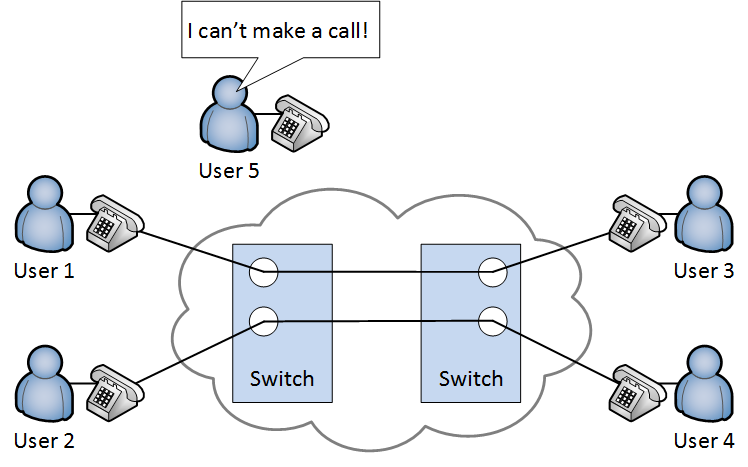
The fifth user has to wait since at that place is no available capacity in our network. We will accept to await until i of the calls is completed so the circuit tin be disconnected.
Later, the operators were replaced by electromechanical automatic telephone exchanges but circuit switching was still used to establish analog phone calls on our PSTN (Public Switched Phone Network) which is also known as POTS (Post Office Telephone Service or Evidently Old Telephone System).
ISDN (Integrated Services Digital Network) as well used circuit switching and supported data rates of 64 kbps per data aqueduct.
The case above explains the limitations of circuit switching. Once the excursion is established, the capacity is reserved for that excursion.
The problem with excursion switching is the limited capacity that it offers. Once the circuit is established, yous brand a reservation in the network and you end up with a fixed capacity for the circuit. It doesn't matter how much data you transmit or non, the circuit will exist there for y'all. This also means that you waste material a lot of unused resources…
Package Switching
The thought backside it is that we break our data down in "chunks". Each chunk is a packet that is sent on the network. This is what we mostly use on our networks nowadays. Here's a visualization:
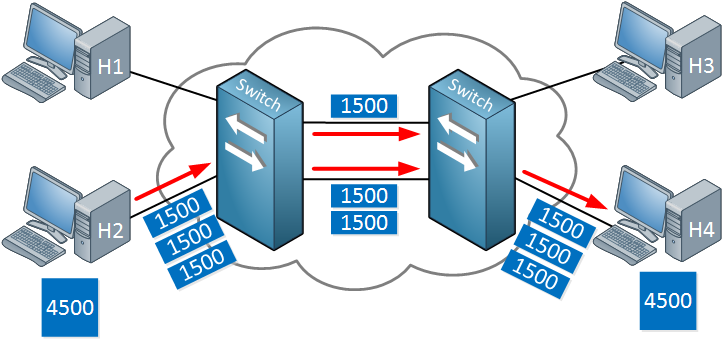
In a higher place you can see that host 2 wants to ship 4500 bytes of information. This is cleaved down in 3x 1500 byte packets. One bundle is sent on the height link, the other two on the bottom link. With packet switching, in that location's no stock-still path in the network. Once host 4 receives all packets, it can extract and reassemble the information.
The package size is variable, at that place is no fixed size.
Packet switching has mostly replaced excursion switching. Ane of the advantages is that because there are no fixed circuits, we can more than finer use the capacity that the network has to offer. We don't waste matter any unused resources.
Jail cell Switching
Jail cell switching is very similar to packet switching with the exception that we employ a stock-still for our size for our cells. Hither's an example:
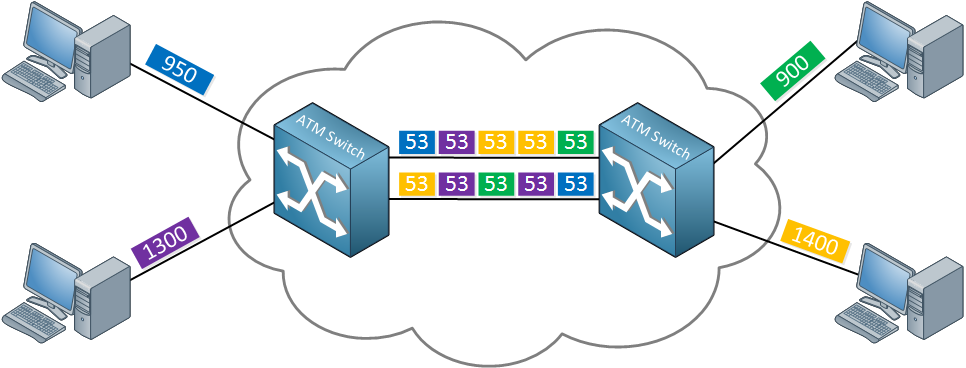
Above you can see that each computer sends some data. Whatever they transport gets encapsulated in cells with a fixed size, 53 bytes in my case. ATM (Asynchronous Transfer Mode) was a pop WAN protocol that used cell switching.
WAN Applied science
So far, nosotros talked nigh some concrete layer terminology and different methods to forrad data on a network. Let's look now at some bodily WAN technologies that we use or used in the past.
Leased Lines
Leased lines are ane of the older WAN options. Imagine we have a LAN in New York and another LAN in Miami. Somehow, nosotros need to connect these two networks. A leased line is a betoken-to-point link that we exclusively use, often offered by a phone visitor. Leased lines have been out at that place for awhile so there are a bunch of other names we use for this:
- T1 / T3 / E1 / E3
- Point-to-point link
- Serial link
- Leased excursion
This bespeak to point link will only be used by the customer that is paying for information technology, which makes it an expensive option. From the customer's perspective, information technology looks like this:
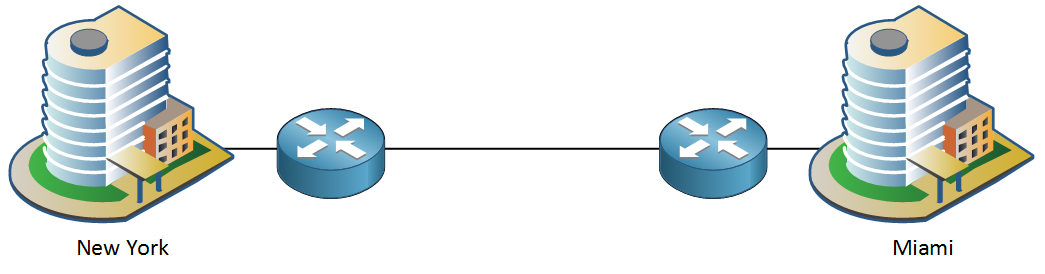
On each site, we use a router with the indicate-to-point connexion in between. In reality, in that location is no unmarried connection that spans the ~1300 miles between New York and Miami. The phone company has multiple buildings throughout the country with their equipment, chosen COs (Fundamental Office). These COs are continued to most buildings in a city, hoping that they can sell their services some day. When a customer requires a leased line, the phone company creates a connection between COs to build a point-to-point link:

There are a number of different bandwidth options for leased lines. Here are some examples:
| Type | Speed | Region |
| DS0 | 64 Kbps | USA |
| T1 (DS1) | one.54 Mbps | USA |
| T3 (DS3) | 43.736 Mbps | USA |
| E0 | 64 Kbps | Europe |
| E1 | 2.048 Mbps | Europe |
| E3 | 34.368 Mbps | Europe |
In the USA, nosotros have DS (Digital Bespeak) 1, ii and iii. The DS1 option are 24 multiplexed DS0 lines, chosen T1. The DS3 line are 28 multiplexed DS1 lines The E0, E1 and E3 lines are the European equivalents.
Let'due south take a closer expect what the connection of a leased line looks like:
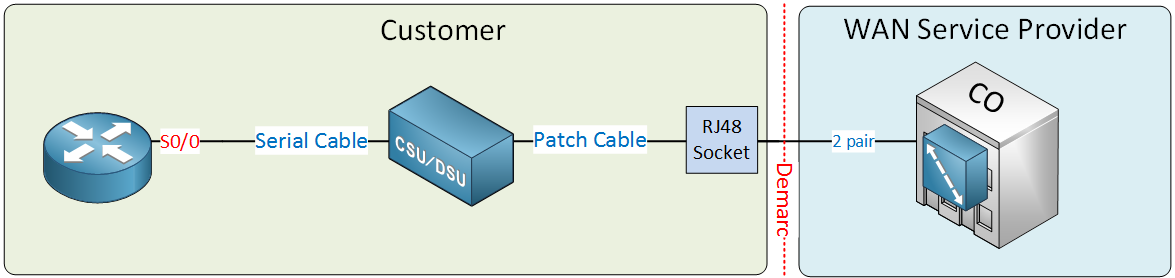
Above nosotros see that the WAN service provider (telephone company) offers a two pair cable to the customer, which terminates in an RJ48 socket. This socket is continued with a patch cable to the CSU/DSU. The CSU/DSU is continued to the router with a series cable to a serial interface.
Let's look at some pictures of these items/devices. Hither'due south a serial interface of a Cisco router:
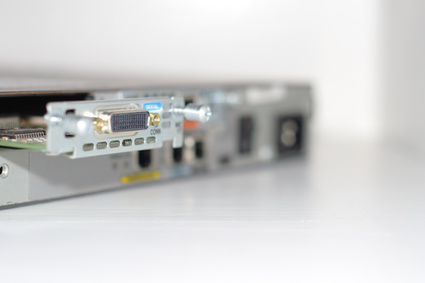
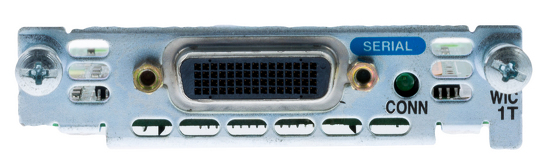
These serial interfaces are WIC modules that you tin can insert in some of the Cisco router models. Here's an example of a CSU/DSU, the DC1200 by Metrodata:
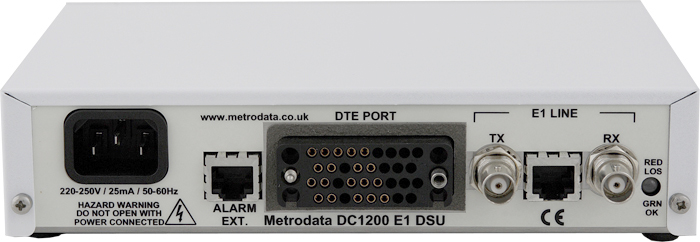
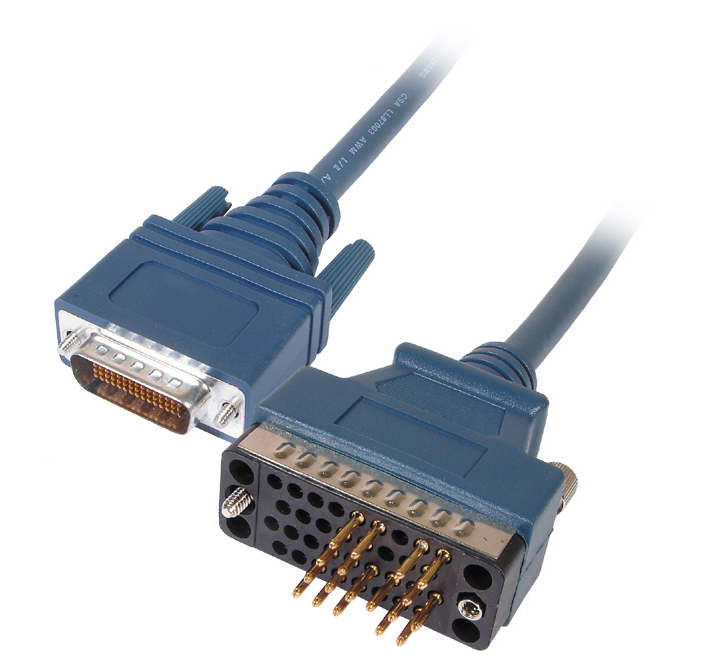
Above you tin see DTE port that has to exist continued to the router. On the right side in that location's the connector for the E1 line. To connect the router to this device, we can use the following cable:
If you want to practice with leased lines in your own lab, so there is no need to buy a CSU/DSU. It is possible to connect two Cisco routers "dorsum to back" with a series cable:
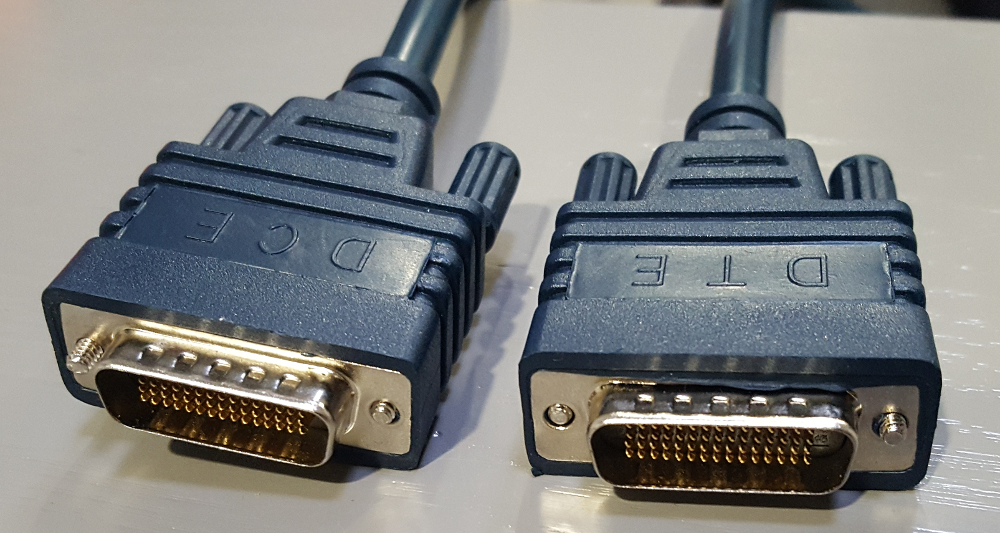
Higher up you can see that ane connector is labeled as DCE, the other equally DTE. To brand a back to back serial link piece of work, you volition have to exercise one thing that normally the CSU/DSU does for you and that is clocking which defines the speed of the link. A Cisco router can configure clocking on the interface, which has to be done on the DCE interface.
On the information link layer, at that place are two protocols nosotros can use on leased lines: PPP and HDLC
Frame-relay
Frame-relay is also an older WAN engineering that was an alternative to leased lines. With a leased line, y'all are the only one using the link and so it's quite an expensive option. Frame-relay offers point-to-bespeak and point-to-multipoint circuits with a shared network, which is cheaper than a defended line.
If you want to learn more about frame-relay, yous can find our frame-relay form here.
DSL
DSL (Digital Subscriber Line) became a very popular option for high-speed Net admission since it uses the analog phone cables that pretty much every home or edifice has. The speed that you get depends on the altitude between your home and the phone visitor.
Hither'southward what DSL looks similar:
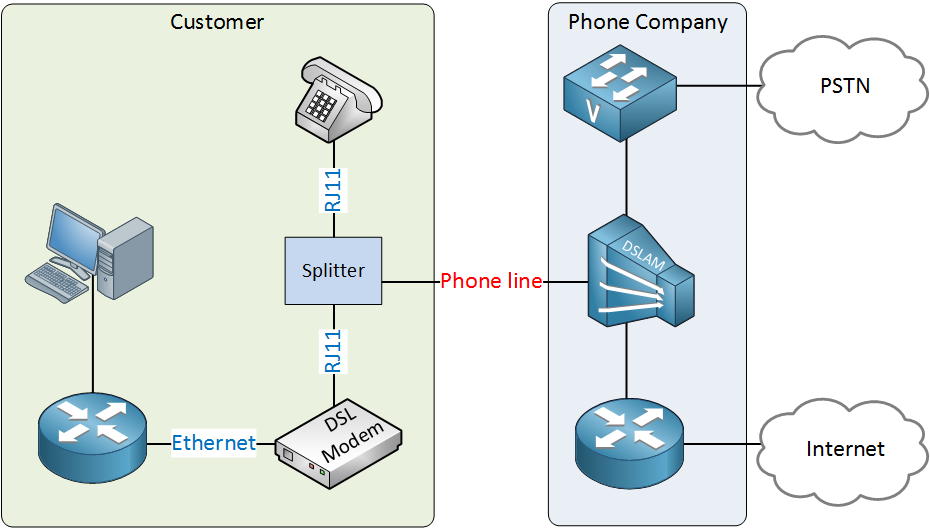
At the customer, nosotros have a splitter that is connected to the phone line that the phone company offers. One RJ11 (phone cable) goes to your analog phones, the other i is connected to a DSL modem. The DSL modem has an Ethernet connexion to your router. Nowadays, the DSL modem is often integrated in the router.
The phone company uses a device called a DSLAM (DSL access multiplexer) which splits the data traffic and voice traffic from each other. Information traffic is forwarded to a router, voice traffic to a voice switch.
Most DSL providers offer disproportionate speeds; the downstream bandwidth is higher than the upstream bandwidth. There are many flavors of DSL like ADSL, SDSL, HDSL and VDSL.
Cable
Cablevision Internet is similar to DSL, it likewise became popular since near homes and buildings take a cablevision connection. Cablevision Internet uses the DOCSIS (Data Over Cable Service Interface Specification) standard to ship data over a coaxial cable.
Coaxial cables offering a wider frequency range than the two pair phone cables we use for DSL, allowing higher throughput. Some cable providers offer ~ 300 Mbit connections.
Cable internet oft offers college bandwidth just this can depend on the number of subscribers on the network. Here's an illustration:
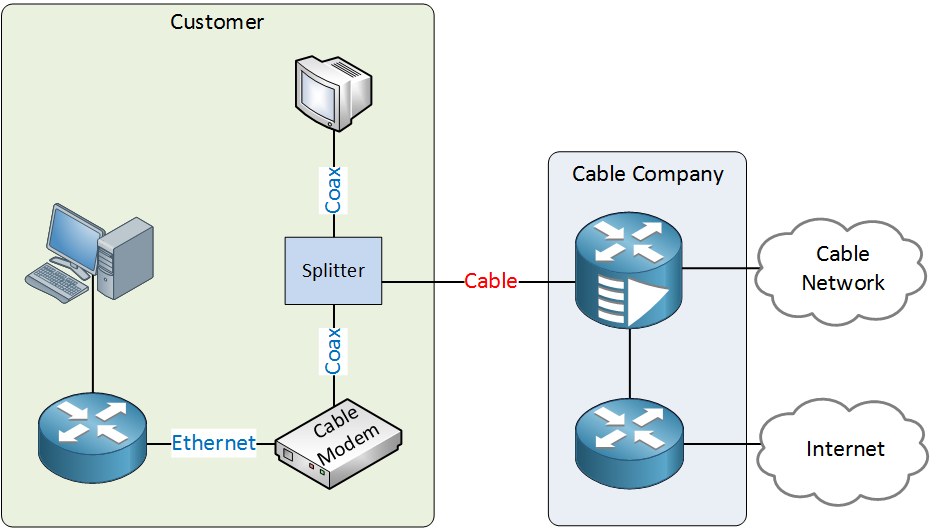
The picture in a higher place is similar to the DSL picture, except we now have coaxial cables and a cablevision modem. On the cable company side, we have to split the video and data traffic.
Ethernet
Ethernet has also made its way to the WAN. The 1000BASE-ZX standard, for example, supports a distance of ~40 miles over single-mode fiber connections. From the customer's perspective, it looks similar to the leased line:
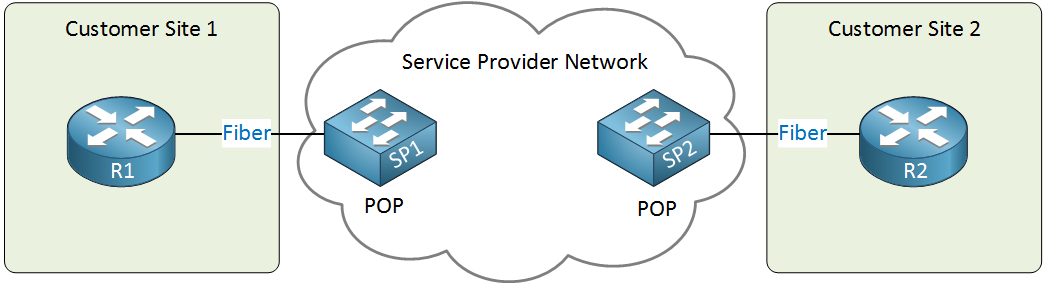
On each customer site, we have a router with a fiber connexion to the Ethernet WAN provider. The connection at the service provider side is called the Popular (Point of Presence). Many providers call this an Ethernet individual line. It'south besides possible to have more than 2 sites, creating a multi-access network.
Ethernet is also used with different "underlying" WAN technologies like EoMPLS (Ethernet over MPLS).
Determination
You take now learned the basics of WANs (Wide Area Network):
- The departure between LANs and WANs.
- The terminology that is used when talking about the WAN physical layer.
- The divergence between circuit switching, package switching, and cell switching.
- Some examples of WAN technologies like leased lines, frame-relay, DSL, cable, and Ethernet.
In the next lessons, we will take a closer look at some of these topics.
hildebrandwitimpet.blogspot.com
Source: https://networklessons.com/cisco/ccna-routing-switching-icnd1-100-105/introduction-to-wans-wide-area-network
0 Response to "What Is the Maximum Distance That an Adsl Modem (Client) Can Be From a Provider's Dslam?"
Post a Comment